LinkedIn Prospecting Message Templates for Sales (2026)
A good LinkedIn prospecting message template gives you a structure, not a script. This page has 24 of them, grouped by where you are in the conversation: the first message after someone accepts, value-led lead generation messages, trigger-based openers and complete outreach sequences. Every template is under 300 characters, and the connection notes are under 200, so they fit LinkedIn's note limit on free accounts (Premium allows 300).
Use them as frames. The parts in square brackets are where the real work happens: a specific, true detail about the person you're writing to.
LinkedIn prospecting message template: the structure
Almost every LinkedIn prospecting message that gets a reply follows the same four beats. The templates below all use some version of it.
- A specific opener about them: a post, a hire, a launch, a shared connection. Not "I came across your profile".
- A relevant observation: one sentence on a problem people in their role usually have.
- Proof or value: a result, a resource, or a short insight. Not a feature list.
- A small question: easy to answer in one line. "Worth a chat?" is fine. "Can we book 30 minutes Tuesday at 3?" is too much for a first message.
{{first_name}} and {{company}} are placeholders a tool can fill in. Text in [square brackets] is what you write yourself for each person. If you can't fill in the brackets with something true, the person probably isn't a good fit yet.
Before messaging, make sure you can. You can message 1st-degree connections freely; anyone else needs a connection request, an InMail or a shared group. Our connection request message templates cover that first step.
LinkedIn prospecting messages examples: the first message after they accept
These LinkedIn prospecting messages examples are for the moment someone accepts your invitation. Don't pitch in the same minute they accept. A few hours, or the next working day, reads as human.
Thanks for connecting, {{first_name}}. Curious: how is {{company}} handling [problem area] right now? I talk to a lot of [role]s about it and the answers vary a lot.
Thanks for accepting, {{first_name}}. I read your post on [topic]. Your point about [detail] matches what we see with [type of customer]. Is that something you're working on this quarter?
Good to be connected, {{first_name}}. Saw {{company}} just [news]. Teams at that stage often run into [problem]. Is that on your radar, or still a way off?
Thanks for connecting, {{first_name}}. No pitch, just a question I'm asking every [role] this month: what's the most annoying part of [process] for your team?
Appreciate the connect, {{first_name}}. I put together a short [checklist/guide] on [topic] for [role]s. Want me to send it over? No strings.
LinkedIn lead generation messages that lead with value
LinkedIn lead generation messages work best when the value comes before the ask. Each of these gives something first: a benchmark, an idea, an introduction or a quick review.
{{first_name}}, we looked at how [number] [type of companies] handle [process]. The fastest ones all do [one thing]. Happy to share the short summary if it's useful for {{company}}.
{{first_name}}, one idea for {{company}}: [specific suggestion based on their site or product]. It worked well for [similar company type]. Want me to explain how in two lines?
{{first_name}}, you mentioned [goal] in your post. I know [name/role] who did exactly that at [company type]. Want an intro?
{{first_name}}, I do a free 15-minute [audit/review] of [thing] for [role]s. Usually spot two or three quick fixes. Interested, or not a priority right now?
{{first_name}}, we're hosting a small session on [topic] for [role]s on [date]. No slides, just people comparing notes. Want an invite?
LinkedIn outreach message template by trigger
A LinkedIn outreach message template built around a trigger is easier to personalize, because the trigger is the reason you're writing. Pick the one that matches what you saw.
Job change
Congrats on the new role at {{company}}, {{first_name}}. First 90 days usually means a lot of [area] decisions. If [problem] is on the list, happy to share what other new [role]s did.
Hiring
{{first_name}}, noticed {{company}} is hiring [roles]. When teams grow that fast, [problem] tends to show up. How are you handling it today?
Funding or expansion
Congrats on the [round/new market], {{first_name}}. Teams usually rethink [process] right after. If that's coming up at {{company}}, I can share what worked for [similar company].
Competitor or tool switch
{{first_name}}, saw {{company}} is moving off [tool]. A lot of teams we talk to hit [specific issue] in the switch. Happy to share a checklist if you're mid-migration.
Content engagement
{{first_name}}, saw you liked [post author]'s post on [topic]. I've been writing about the same problem from the [angle] side. Curious what made it resonate for you?
{{first_name}}, thanks for the comment on my post about [topic]. You raised [point]. How does that play out at {{company}}?
LinkedIn outreach templates: complete sequences
These LinkedIn outreach templates are short sequences: a connection note, a first message and a follow-up. Space the steps a few working days apart, and stop the moment someone replies.
Sequence A: the soft opener (founders and small teams)
Hi {{first_name}}, I work with [role]s at [company type] on [topic]. Your work at {{company}} looks close to what I do. Happy to connect.
Thanks for connecting, {{first_name}}. How does {{company}} handle [process] today? Asking because most teams we meet either [option A] or [option B], and both have trade-offs.
{{first_name}}, one more thought: [short insight or result]. If it's not a priority, no worries at all. Just let me know and I won't follow up.
Sequence B: the resource-led sequence (marketing and agencies)
Hi {{first_name}}, I publish [resource type] on [topic] for [role]s. Saw your post on [topic] and thought you'd find it useful. Let's connect.
Thanks, {{first_name}}. Here's the [resource] I mentioned: [one-line summary]. Want the full version? Happy to send it.
{{first_name}}, did the [resource] land? Most [role]s tell me [section] is the useful bit. If you want to talk through it for {{company}}, I'm around.
Sequence C: the direct sales message (clear fit, busy buyers)
{{first_name}}, short version: we help [role]s [outcome] without [pain]. [Similar company] got [result]. Worth a 15-minute look for {{company}}?
{{first_name}}, bumping this once. If timing is off, a one-word "later" helps me not pester you.
More follow-ups for when nobody answers are in our LinkedIn follow-up message guide.
How to test which LinkedIn outreach message works
Templates are hypotheses. The only way to know which LinkedIn outreach message works for your market is to test, and to test one thing at a time.
- Pick one variable: the opener, the question, the offer or the length. Not all four.
- Split a single list in half so both versions go to similar people in the same weeks.
- Send at least 100 of each before deciding. Smaller samples are mostly noise.
- Measure positive replies, not just replies. A clever message that gets "unsubscribe me" isn't winning.
- Keep the winner, then test the next variable.
What usually moves the numbers
| Change | Typical effect |
|---|---|
| Specific opener instead of generic | More replies, and better ones |
| Question instead of meeting request | More replies, slower path to a call |
| Shorter message | Easier to read on a phone |
| Resource offer | Good for cold audiences who aren't ready to talk |
| Trigger-based list (hiring, new role) | Often the biggest lift of all |
The list usually matters more than the words. If a template underperforms across two different lists, change the template. If it works on one list and fails on another, change the list.
Message template for LinkedIn: making it personal at scale
Any message template for LinkedIn loses its edge when 200 people get the same words. The fix is not more templates; it's filling the brackets with real details. That's slow by hand: reading a profile, skimming a post, checking the company site. Five minutes a lead adds up quickly.
LinkedIn sales message template tips
- Keep it under about 300 characters (a LinkedIn character counter makes this easy). Long LinkedIn messages look like email blasts.
- One question per message. Two questions get zero answers.
- No links in the first message. Offer to send one instead.
- Write like you talk. Read it out loud before sending.
- Track replies by template so you know which LinkedIn outreach message to keep.
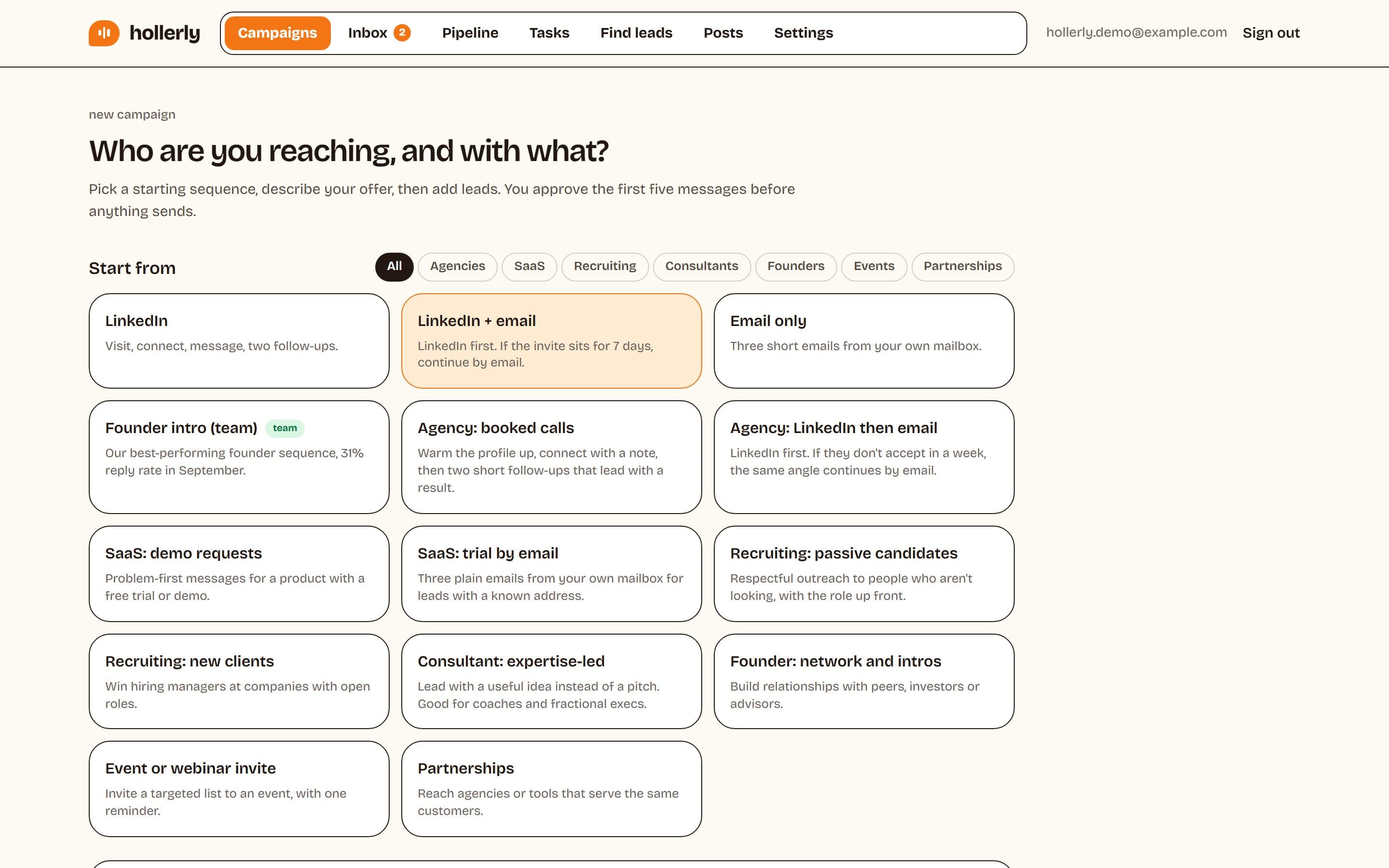
Hollerly does the research part for you. For every lead it reads the profile, their latest post and a short summary of their company website, then Claude writes the note, message and follow-up in your tone. You approve the first five, then it runs inside LinkedIn's safe limits and stops when someone replies. On Pro, A/B tests pick the better-performing message automatically. See message automation, LinkedIn prospecting and pricing, which starts at $19 a month.
FAQ
+What is a good LinkedIn prospecting message?
A good LinkedIn prospecting message opens with something specific about the person, names one problem people in their role often have, offers a small piece of value and ends with an easy question. It stays under about 300 characters, has no link, and never pitches in the same breath as the connection request.
+How long should a LinkedIn outreach message be?
Short. Connection notes must fit 200 characters on free accounts and 300 on Premium. First messages after someone accepts work best at two to four sentences, roughly 200 to 300 characters. If it needs scrolling on a phone, it's probably too long for a first touch.
+How many follow-ups should I send on LinkedIn?
Two follow-ups after the first message is a sensible limit for most prospects, spaced four to seven working days apart. Each should add something new, not just ask whether they saw the last one. Stop immediately when someone replies, and respect a no.
Get replies without the busywork
Hollerly finds the people, writes every message with AI and follows up on LinkedIn and email until they reply. Runs in the cloud, from $19 a month.
Start my 7-day free trial